
Summer's over, the buses are running, and in a few weeks a hundred small feet are going to hit your playground at full speed. Before that happens, it's worth five minutes to ask: is it actually ready for them?
Florida throws a lot at a playground in three months: sun, salt air, afternoon storms, humidity that doesn't quit. A structure that looked fine in May can have loose hardware, washed-out surfacing, or a shade sail that didn't survive hurricane season by August. For schools and daycares, that's not just a maintenance issue. It's a liability and licensing one too.
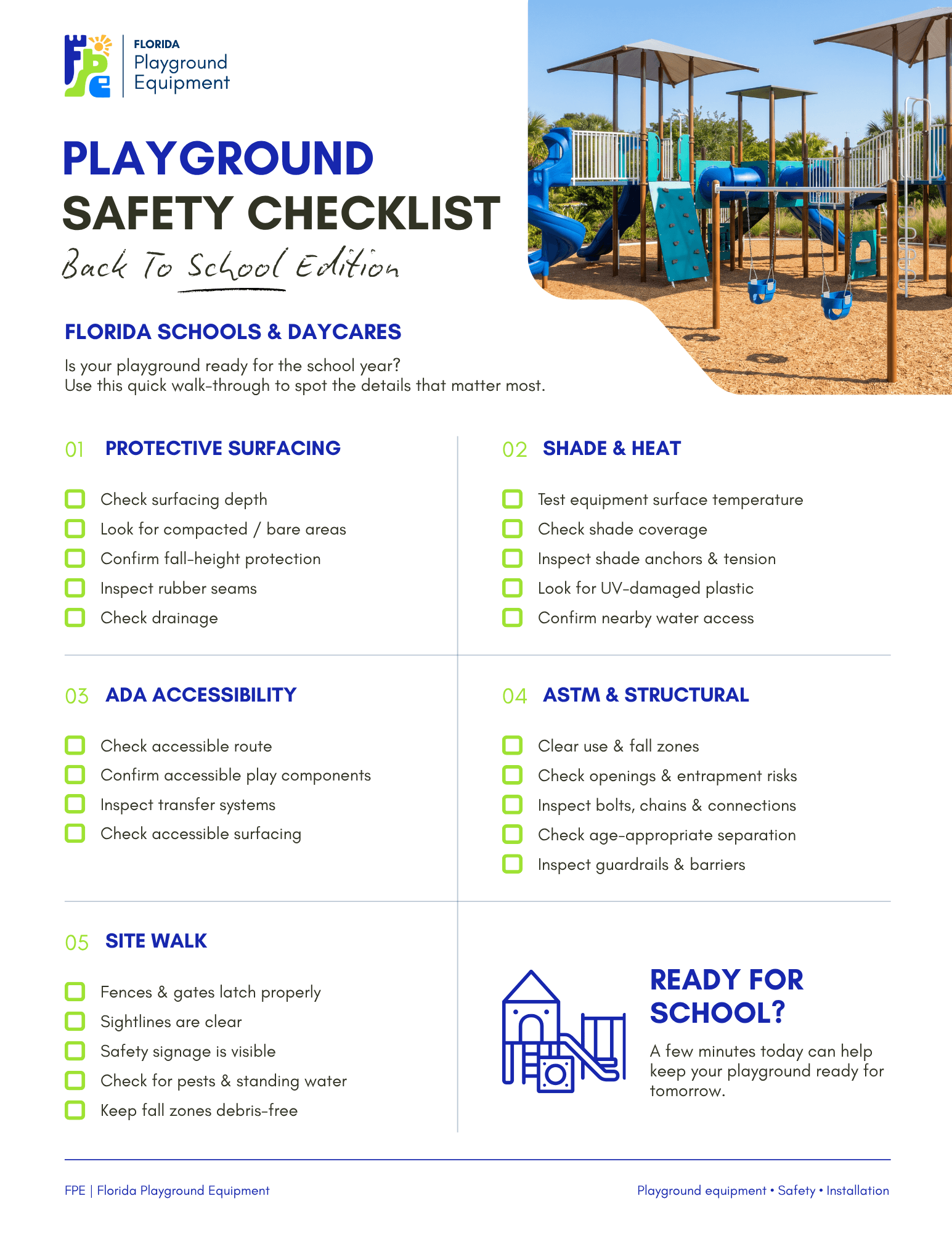
We put together the same walk-through checklist our crews use before a site reopens, organized around the areas inspectors, and insurers, actually look at first: surfacing, shade, accessibility, and hardware. Grab a clipboard, or download the printable version below, and walk your site before the first bell rings.
Protective surfacing
Start at the ground, because falls are the most common playground injury and the surface is what decides how a fall ends.
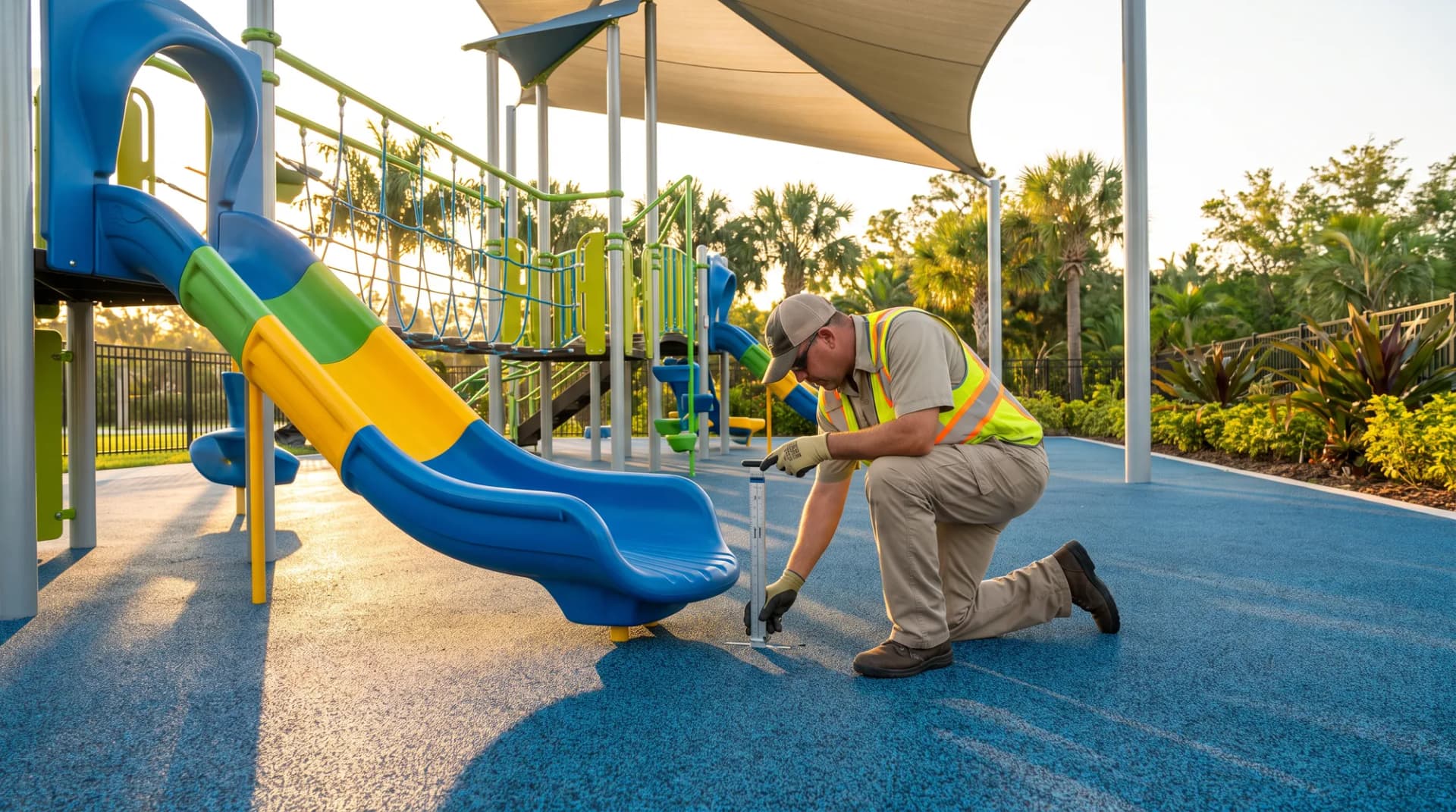
Loose-fill surfacing like engineered wood fiber, mulch, or sand moves. Kids scoop it, storms wash it, and foot traffic packs it down, so the spot under a slide exit or a swing that had plenty of depth in the spring can be close to bare by fall. Push a gauge or a ruler into the surfacing under every high-traffic area and compare what you find to the depth it was installed and rated for. Most loose-fill guidance lands around nine inches of compressed depth for typical equipment, but the number that matters is the one for your material and your tallest fall height, so check it against the manufacturer's spec.
Then look at the pattern. Hard-packed patches, bare dirt, and puddles that linger after an afternoon storm all mean the surfacing isn't doing its job. On poured-in-place rubber or rubber tiles, run your eye and your hand along the seams. Lifted edges, cracks, and gaps are trip hazards, and sun and moisture only make them grow. Last, make sure the area drains. Standing water breaks surfacing down, and it breeds mosquitoes right where kids play.
Shade and heat
Shade isn't a nice-to-have in Florida. Slides, platforms, and dark plastic can get hot enough to burn skin in direct sun, so touch them at the time of day kids will actually be outside, not just first thing in the morning. If you can't comfortably hold your palm on a surface, a child can't either, and that spot needs shade, a different schedule, or both.
Then look up. Shade sails and structures take the brunt of storm season, so check the anchors and footings, the tension in the fabric, the stitching, and the hardware at every corner. Sagging, fraying, or fabric that has gone chalky and brittle has lost some of its life. The same goes for UV-damaged plastic: faded, chalky, or cracked panels and slides can turn brittle. And confirm there's water within easy reach, because kids playing in Florida heat need somewhere close to cool down and drink.
ADA accessibility
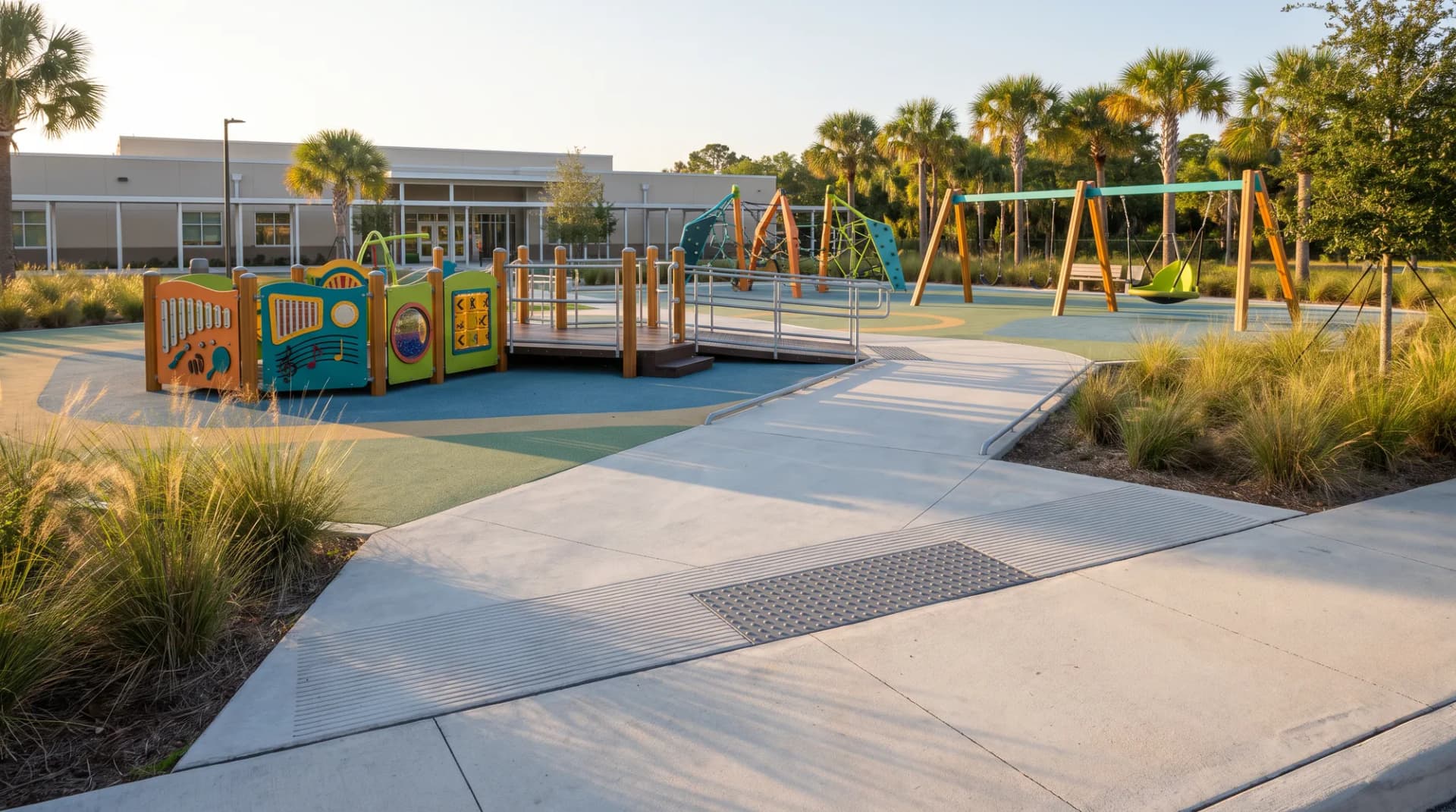
An accessible playground starts before the equipment does. Walk the route from the parking lot, drop-off, or building entrance to the play area the way a child using a wheelchair or a walker would. Is the path firm and wide enough, free of gaps and lips, and does the gate open far enough to get through? Then look at what's inside: are there accessible play components at ground level, and where equipment is elevated, are the ramps and transfer systems intact and usable?
Finally, check the surface itself. Loose-fill can lose its accessibility as it compacts, scatters, or washes away from entry points, so accessible surfacing needs regular attention, not just a check on installation day.
ASTM and structural checks
This is the part of the walk where a wrench and a sharp eye earn their keep. Start with the use zones, the space around and under each piece of equipment. They need to stay clear of anything a child could hit or trip on, and it's surprising how often a bench, a planter, or a tree root has crept in over the summer.
Next, look for openings and gaps where a head, neck, or clothing could catch, especially where a part has been replaced or repaired. Check every bolt, chain, S-hook, and connection. Hardware works loose over a season of use, and in salt air and humidity, metal corrodes faster than you'd expect. Look for protruding or missing bolts, worn swing hangers and chains, cracked plastic, and splintered wood. Confirm the equipment for younger and older kids is still separated, and that guardrails and barriers are solid and intact.
The site walk
Save the last lap for the big picture. Do fences and gates latch properly? Can staff see the whole play area from where they supervise, or have grown-in shrubs created blind spots? Are safety and age-group signs visible and readable? Look for pests and standing water too, from wasp nests under platforms to fire ants in the mulch. And clear the fall zones of debris, especially after a storm, when branches and palm fronds can pile up overnight.
Write it down
Whatever you find, write it down. A dated checklist that shows who walked the site, what was checked, and what was fixed is the simplest proof that your playground is being looked after, and it's exactly the kind of record insurers and licensing inspectors like to see. Fix what you can in-house, and close off any piece of equipment you can't make safe until it's repaired. For anything that needs a closer look, a certified inspector can give you a formal assessment, and that's what our playground safety inspections are for.
Don't walk the site without it
We turned this into a printable, room-by-room checklist your facilities team or director can run in one lap of the playground. No guesswork, no missed sections.
FPE inspects, supplies, and installs playgrounds across Florida schools, daycares, and municipalities: 150+ playgrounds and 80+ schools and municipalities served, to ASTM, ADA, CPSC, and ISO 9001/14001 standards. If your walk-through turns up a problem, we're already the people who know how to fix it.
Download the Free Florida Playground Safety Checklist
Found an issue on the walk-through?
From a resurfacing job to a full playground replacement, we'll help you scope it, quote it, and get it done before it becomes a bigger problem.
Need help faster than a kid down a slide? Call us 954-440-2955 or text us on WhatsApp!
Planning something bigger than a repair? Our 2026 guide to Florida playground grants and funding covers where schools and daycares can find money for a full rebuild.
A great playground year starts with five minutes before the first bell. Walk it, check it, and let the kids do the rest.